Many leaders treat the ServiceNow CMDB as a "set it and forget it" database. In reality, it is a living ecosystem. When it fails, it’s usually because the organization treated it like a giant spreadsheet rather than a dynamic map of business value.
Here is a fresh look at the primary points of failure and how to pivot toward success.
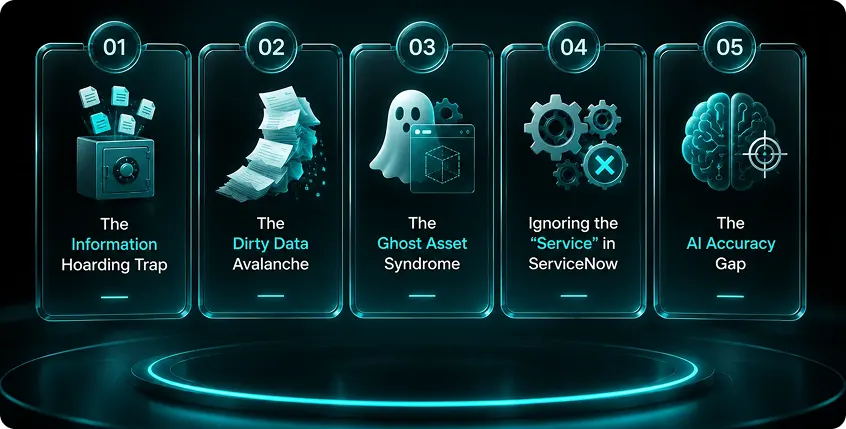
The "Information Hoarding" TrapThe Problem: There is a common misconception that more data equals more value. Teams often try to ingest every possible attribute for every device on the network. This creates "data noise" that buries critical insights. The Pivot: Value-Stream Mapping. Stop asking "What can we discover?" and start asking "What do we need to know to keep the business running?" Map your most profitable services first. By focusing on the infrastructure that actually generates revenue, you ensure the CMDB provides immediate ROI.
The "Dirty Data" AvalancheThe Problem: Without strict gatekeeping, a CMDB quickly becomes a "data swamp." Multiple discovery tools might report the same server under different names, leading to duplicate records and a total loss of trust in the platform. The Pivot: Algorithmic Governance. Use the Identification and Reconciliation Engine (IRE) as your "bouncer at the door." You must establish a clear hierarchy of truth deciding, for instance, that your cloud provider’s data overrides your manual entries. If the data isn't verified through a trusted source, it shouldn't be in the system.
The "Ghost Asset" SyndromeThe Problem: A CMDB is only as good as its last update. Organizations often fail because they don't have a process for the "end of life." Servers are decommissioned in the real world but live forever as "ghosts" in the CMDB. The Pivot: Automated Life-cycle Workflows. Instead of relying on manual cleanup, use the CMDB Data Manager to set expiration dates. If a CI hasn't checked in for 30 days, the system should automatically trigger a task to verify its status or archive it. Accuracy should be automated, not elective.
Ignoring the "Service" in ServiceNowThe Problem: Technical teams often build a "Technical CMDB" (servers, IPs, storage) while the business operates on a "Service Layer" (Email, Payroll, CRM). The two sides rarely meet. The Pivot: Adopting the CSDM Framework. The Common Service Data Model (CSDM) is the blueprint for connecting technical components to business outcomes. By aligning your data to this framework, you ensure that when a router fails, the dashboard doesn't just show a red light it tells you exactly which department’s productivity is currently at a standstill.
The AI Accuracy GapThe Problem: As we move toward AI-driven IT operations, "hallucinations" occur when AI agents rely on a broken CMDB. A 90% accurate CMDB was once acceptable; for autonomous AI, it's a disaster. The Pivot: Continuous Attestation. Shift the culture of ownership. Through Data Certification, the system should periodically "check in" with asset owners. This forces human accountability, ensuring that the data fed into AI models is high-fidelity and actionable.