ServiceNow SecOps

  • Home
  • ServiceNow SecOps

ServiceNow SecOps: Closing the Gap Between Alerts and Actual Resolution.

img
Organizations are drowning in "Alert Fatigue." Their SOC (Security Operations Centre) is firing on all cylinders, yet the mean time to resolve (MTTR) remains stagnant. The gap isn't a lack of tools; it’s a failure of orchestration.
By mid-2026, the game will have changed. We are no longer just "integrating" tools; we are deploying Agentic SecOps. Here is how we bridge the gap between a flashing red alert and a confirmed resolution.


Moving Beyond "The Wall of Alerts"

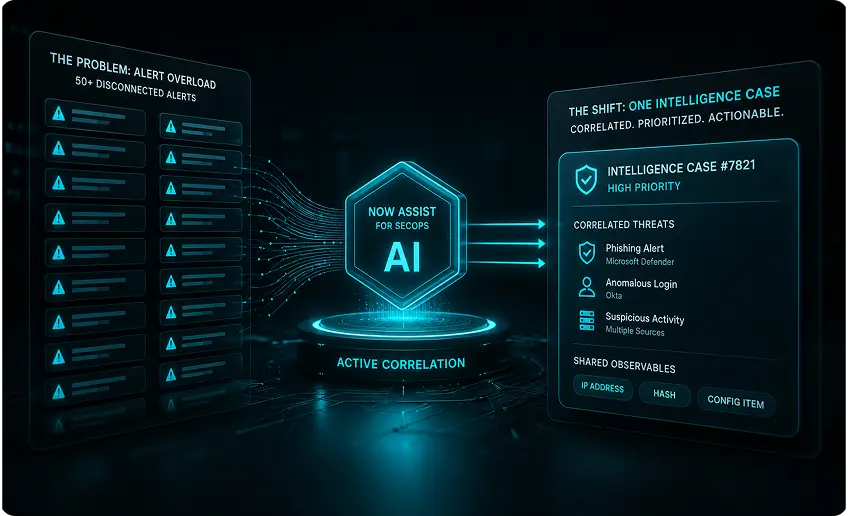
The Problem: Most SOCs treat alerts as isolated tickets. Analysts waste 30% of their day manually correlating a phishing alert in Microsoft Defender with an anomalous login in Okta.
The 2026 Fix: Correlation Insights with Now Assist
ServiceNow’s Now Assist for SecOps (Generative AI) has moved from simple summarization to Active Correlation.
  • The Shift: Instead of seeing 50 alerts, your analysts see one Intelligence Case.
  • Axion AI Strategy: We configure Correlation Insights to automatically group incidents sharing the same observables (IPs, hashes, or CIs). This turns a chaotic queue into a prioritized list of actual threats, closing the "noise gap" immediately.
img

From Playbooks to "Agentic Workflows"

The Problem: Traditional playbooks are often "static." They tell an analyst what to do, but they don't do it. This manual hand-off is where resolution speed dies.
The 2026 Fix: MITRE D3FEND Automation
As of Q1 2026, ServiceNow has integrated MITRE D3FEND directly into the Security Incident Workspace.
  • The Shift: It doesn't just map the attack (ATT&CK); it suggests the specific Defensive Countermeasure.
  • Axion AI Strategy: We help clients transition from "Human-Led" to "Human-in-the-Loop" automation. Using Agentic Workflows, ServiceNow can automatically trigger a firewall block or isolate a host via CrowdStrike/SentinelOne, requiring only a single click (or a "silent" approval) from the analyst.

Bridging the SecOps-ITSM Cultural Chasm

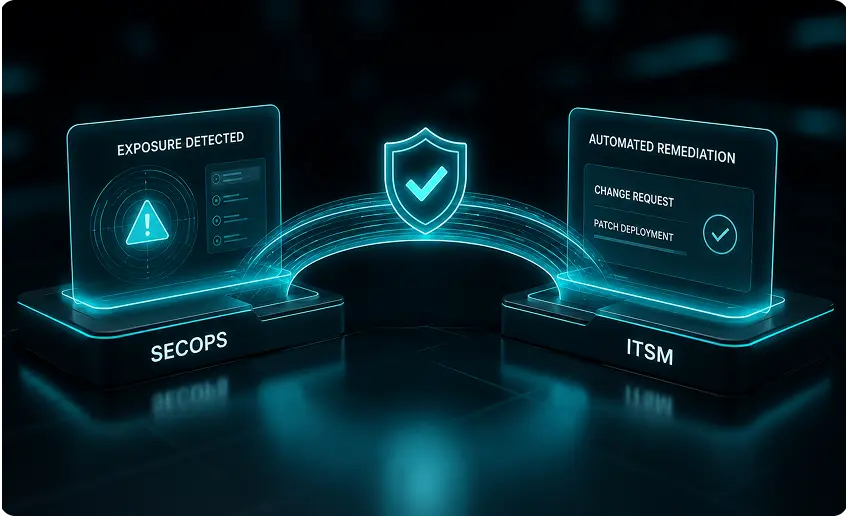
The Problem: Security finds the hole; IT is supposed to patch it. This "hand-off" via email or disparate systems is where vulnerabilities sit for months.
The 2026 Fix: Unified Security Exposure Management
The silos are being demolished by the Unified Security Exposure Management workspace.
  • The Shift: Security and IT now look at the same risk-scored dashboard.
  • Axion AI Strategy: We implement Vulnerability Response (VR) with Automated Remediation Tasks. When a critical vulnerability is found, ServiceNow automatically creates a Pre-Approved Change Request for the IT team, including the specific patch needed. The gap is closed because the "ask" is delivered in the language IT speaks (a Change Ticket), not a scary PDF report.
img

Closing the Loop: The AI Post-Mortem

The Problem: We resolve the incident but fail to learn from it. Reporting and "Lessons Learned" are usually skipped because the next alert is already screaming for attention.
The 2026 Fix: Automated Post-Incident Analysis (PIA)
Now Assist now generates comprehensive closure notes and root cause assessments automatically.
  • The Shift: What used to take an hour of documentation now takes 60 seconds of AI generation and 30 seconds of human review.
  • Axion AI Strategy: We leverage these AI-generated PIAs to update Threat Intelligence feeds. If an attack was resolved, the "lesson" is fed back into the system to prevent a similar alert from ever firing again.

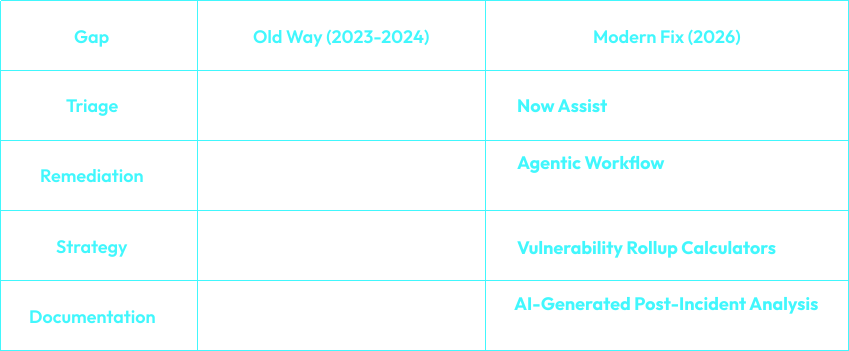
The Axion AI Performance Checklist

img

Final Thought from Axion AI

"Closing the gap" is no longer about working faster; it's about removing the work. By leveraging ServiceNow's 2026 AI capabilities, we turn your security team from "firefighters" into "fire inspectors."